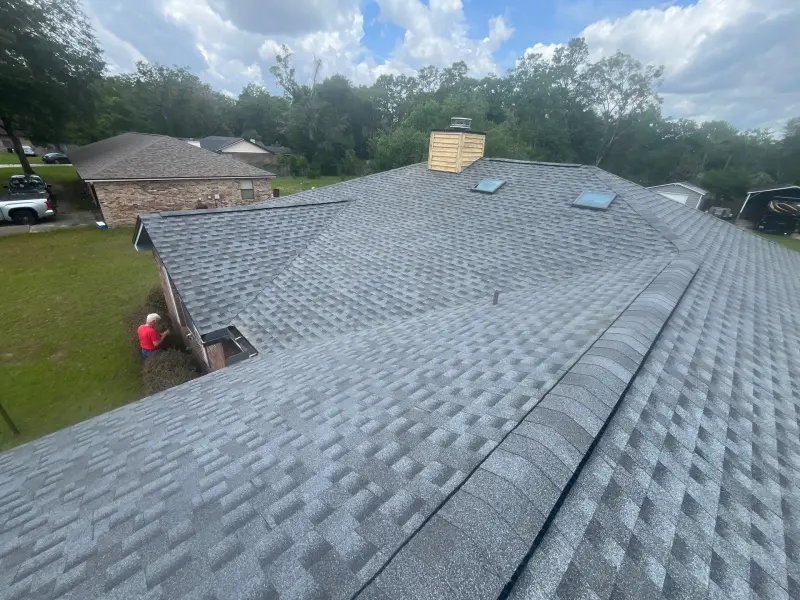
A Central Florida HOA called us about a problem no board expects five years into a building’s life: 176 townhomes with recurring leaks, climbing maintenance costs, and roof lines that had visibly started to move. Our Orlando team inspected all 19 buildings. The findings were consistent across the community, which told us this wasn’t a handful of bad roofs — it was something systemic.
The detail that worried the board most was how they described it: “the boards in the roof are bowing.” That’s roof sheathing buckling along the panel seams. It looks alarming from the ground, and on a community still considered new construction it raises a fair question — how does this happen so soon?
What sheathing buckling actually is
Roof sheathing is the layer of OSB or plywood panels that spans the trusses and carries the underlayment and shingles. Those panels expand and contract with heat and humidity. That movement is normal and expected, which is why they’re meant to be installed with a gap between them.
When there’s nowhere for that expansion to go, the panels press against each other and lift at the seams. You get a washboard look through the shingles, and over time the seams work against the fasteners and the underlayment above them.
Florida’s building code is specific about materials and installation, so the decking itself is rarely the culprit. In our experience the cause is almost always how the roof was assembled and how the attic below it breathes.
The three causes we look for first
Panels installed too tightly
OSB and plywood roof decking is designed to go down with roughly a 1/8-inch gap between panels. That gap is the expansion joint. Close it up and the panels have no relief — they swell in Florida heat and humidity and buckle along the seams.
This is one of the more common defects we find in large production-built communities, where the same crew sheathes building after building on a tight schedule. If the spacing was missed, it was likely missed everywhere, which is exactly the pattern we saw across all 19 buildings.
Attic ventilation that can’t keep up
Attached housing is harder to ventilate than a detached home. Shared walls and firewalls interrupt airflow, and the attic space over each unit is narrower than it looks from outside.
Without balanced intake at the eaves and exhaust at the ridge, heat and moisture sit in the attic instead of moving through it. The decking absorbs that moisture and expands past what the assembly can absorb. The same conditions shorten the service life of the shingles, the fasteners, and the underlayment.
Fastening problems
Sheathing that’s under-nailed, over-driven, or nailed off-pattern loses rigidity. Overdriven nails crush the panel face and lose their grip; too few nails let the panel flex between trusses. Either way the panel moves more than it should, and the seams telegraph through the shingles.
Why three-tab shingles made it more visible
This community was roofed with three-tab shingles, which show up often in new-build communities because they’re the lower-cost option.
Three-tab shingles are flat and thin. They have less structural rigidity and lower wind ratings than architectural shingles, and critically for this HOA, they hide nothing. Every ridge and buckle in the deck reads straight through the surface. An architectural shingle has enough dimension to mask minor deck movement; a three-tab telegraphs it.
The practical results tend to be recurring leaks at the seams, tabs lifting or blowing off in storms, higher year-over-year maintenance spend, and a roof that reaches the end of its usable life well before the board budgeted for it.
What a forensic inspection covers
A roof this young failing this consistently deserves a diagnosis, not a patch. Before recommending any scope of work, we document the whole assembly:
- Attic spaces, including airflow paths between units
- The intake and exhaust ventilation, measured against the roof area it serves
- Sheathing panel spacing and fastening at connection points
- Moisture readings in the decking
- Every location with known leak history
That gives a board something it can act on: the actual cause, how far it extends, and what a durable fix costs versus another year of leak calls.
Why boards should look into this early
Roofing problems in attached housing don’t stay in one unit. Water that enters at a seam can travel along the deck and show up two units away, and the repair conversation gets more expensive the longer the pattern continues.
Acting early lets a board solve the root cause instead of chasing symptoms, reduce repeat leak-response costs, extend the life of the roof system that’s already in place, improve attic performance and cooling load, and build the documentation needed for reserve planning.
That last point matters more than boards expect. A reserve study built on an assumed 20-year roof life is wrong if the real number is closer to eight, and finding that out during budget season is better than finding out during a hurricane.
One thing to do before anything else
Locate your construction documents. A five-year-old community may still be inside a workmanship or material warranty period, and warranty terms differ sharply depending on who installed the roof and what was registered at the time. Those documents also establish what was specified versus what was actually built — which is the difference between a warranty conversation and a maintenance expense.
Pull them before you commission any work. An inspection report is far more useful when it can be read against the original spec.
Working with HOAs and property managers across Florida
If your community has recurring leaks, wavy or buckling roof lines, ventilation problems, or roofs aging faster than the reserve study assumed, we can help you find out why.
We provide roof and attic inspections, full forensic evaluations, reserve study support, repair and replacement recommendations, and project management for community-wide work. Our teams serve HOAs, property managers, and asset managers across Central and North Florida, on both commercial and residential properties.
Start with a roof inspection, or request an estimate if you already know the scope you need.
Frequently Asked Questions
Can a five-year-old roof really need replacing?
Yes, though it’s usually a sign of an installation or ventilation problem rather than normal wear. A roof that fails this early typically has a specific, identifiable cause — panel spacing, ventilation, or fastening — and that cause should be documented before anyone decides on a repair or a replacement.
What does it mean when an HOA says the boards in the roof are bowing?
It almost always describes roof sheathing buckling. The plywood or OSB panels under the shingles have expanded and lifted along their seams, creating a visible wave or ridge pattern across the roof surface.
Is buckling sheathing a structural problem?
The panels themselves are rarely a safety concern, but buckling compromises the weather barrier above them. Seams that move work against fasteners and underlayment, which is why buckling and recurring leaks tend to show up together.
Are three-tab shingles a bad choice for Florida communities?
They’re a lower-cost option with lower wind ratings and less rigidity than architectural shingles. They can perform adequately when installed correctly over a sound deck, but they show underlying deck movement much more readily and generally offer a shorter service life in Florida’s climate.
Should an HOA get a forensic inspection or just a repair quote?
If the same problem appears across multiple buildings, a forensic inspection is worth the step. A repair quote prices a symptom. A forensic inspection identifies the cause and how far it extends, which is what a board needs to budget accurately and to evaluate any warranty position.